Planning for a Kickstarter Campaign in 2026: The New Standard for Crowdfunding
- Captivate
- 2025年12月11日
- 讀畢需時 4 分鐘
The "golden era" of crowdfunding isn't over—it has just evolved.
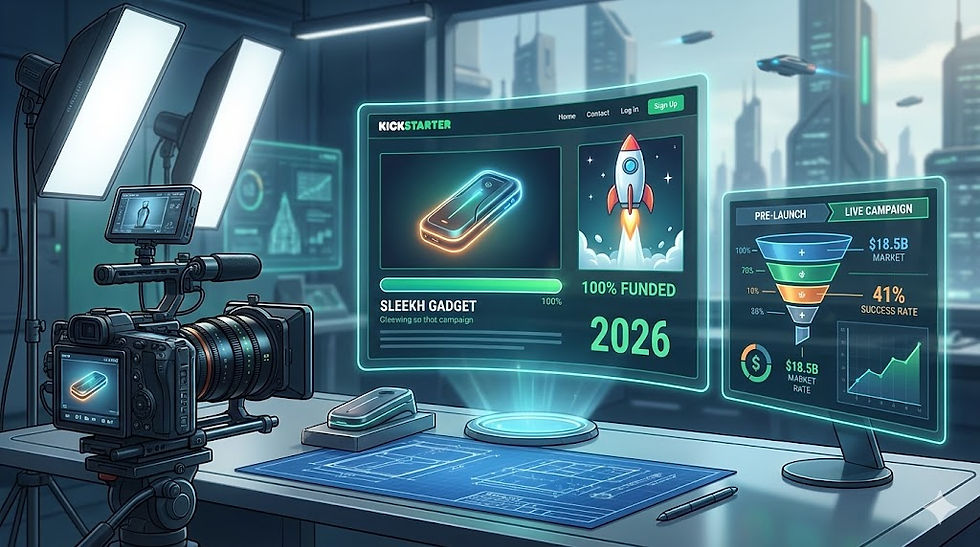
As we move into 2026, the global crowdfunding market is projected to reach over $18.5 billion, driven by a massive shift in how consumers discover new products. It is no longer just a fundraising mechanism; it is the world’s premier stage for product validation and brand building.
For creators, the potential has never been higher. We are seeing campaigns scale faster than ever before, fueled by algorithmic discovery and a backer community that is eager to support the next big innovation. But with this massive potential comes a critical caveat: the "amateur" aesthetic is dead.
The 2026 Shift: Why "Good Enough" is No Longer Enough
If you looked at a top-tier campaign in 2020 vs. 2026, the difference is stark. The platform has matured, and so have the backers.
With major brands now using Kickstarter to launch new lines, the platform is saturated with high-fidelity content. Backers today have been burned by failed projects in the past, and their primary filter for trust is production value.
The Campaign Page: It’s no longer just text and images; it’s a scrolling, mobile-optimized experience. Backers expect clean graphic design, clear infographics, and a seamless flow that rivals Apple’s product pages.
The Video: This is your 3-minute Super Bowl ad. In 2026, a webcam pitch doesn’t cut it. Backers expect cinematic lighting, professional sound design, and tight scripting. If your video looks low-budget, backers assume your product manufacturing will be too.
The competition is fierce. To stand out, you don't just need a great idea; you need to look like a company that is ready to deliver it.
The Reality Check: 2025 by the Numbers
To understand the challenge, we need to look at the data. According to platform statistics updated in 2025, the global success rate for Kickstarter campaigns hovers around 41%. This means that despite the hype, the majority of projects still fail to reach their initial funding goal.
Even more telling is the "Six-Figure Club." Out of over 650,000 projects launched on the platform to date, fewer than 2% have ever broken the $100,000 mark.
These numbers highlight a stark reality: Viral success is not accidental; it is engineered.
Reaching that top tier requires more than just a good product. It demands a rigorous pre-launch strategy to ensure you are not relying on luck, but on a calculated marketing engine that guarantees funding on Day 1.
The AI Dilemma: Balancing Innovation with Authenticity
In 2026, AI tools have revolutionized creative workflows. From generating stunning mood boards to polishing copy, AI is a powerful asset for keeping costs down and creativity up. However, relying on it too heavily can be a fatal mistake.
As AI-generated video and imagery become indistinguishable from reality to the untrained eye, backer skepticism has risen. A campaign page filled with AI renderings or generated product demos often raises red flags: Does this product actually exist? Is this team hiding a lack of progress?
Authenticity is your most valuable currency.
Realism is Non-Negotiable: While AI can enhance your story, your core assets must be real. Backers need to see a physical prototype being held, used, and tested by real humans.
The "Uncanny Valley" of Trust: Over-polished, AI-generated faces or voiceovers can feel impersonal. A slightly imperfect video of the founder explaining the passion behind the project often converts better than a flawless AI avatar.
Strategic Usage: Use AI for background assets, storyboarding, or brainstorming, but ensure your "hero" shots are 100% genuine. If backers suspect your product is just a prompt, they won't open their wallets.
The Blueprint: Kickstarter Marketing Procedure
A successful campaign is won or lost long before the "Launch" button is pressed. In 2026, the strategy is broken down into two distinct, equally important phases.
Phase 1: Pre-Launch (The "Pressure Cooker")
Goal: Build a list of VIPs who will back you in the first hour.
You cannot launch to crickets. The Kickstarter algorithm rewards momentum, so you need to bring your own crowd.
Lead Generation: Run Meta/TikTok ads driving traffic to a landing page (not Kickstarter yet).
The Reservation Funnel: Don't just ask for emails; ask for a $1 deposit to reserve the best price. A backer who pays $1 now is 30x more likely to buy the full product later.
Community Building: Invite these VIPs into a private Facebook Group or Discord. Engage with them, show them behind-the-scenes content, and let them feel like co-creators.
The "Hype" Week: In the 7 days leading up to launch, ramp up email frequency. Reveal the price, reveal the launch time, and build urgency.
Phase 2: Live Campaign (The "Momentum Machine")
Goal: Sustain traffic and convert casual browsers.
Day 1 Blitz: Direct your entire email list to pledge immediately. Your goal is to hit 100% funded in under 24 hours. This triggers Kickstarter's algorithm, pushing you to the front page.
Mid-Campaign Advertising: Once funded, switch your paid ads to direct traffic to the live Kickstarter page. Use social proof (e.g., "Funded in 1 hour!") in your ad copy.
Cross-Promotion: Partner with other live campaigns. "I'll mention you in my update if you mention me in yours." This is free, high-quality traffic.
Ready to Captivate the Market?
Planning a Kickstarter in 2026 requires more than just passion; it requires a production team, a marketing strategist, and a launch partner.
If you have the product but need the professional polish—from cinematic video production to high-converting campaign page design—we are here to help you bridge the gap.
Need professional help ensuring your launch is a success? Contact Us at Captivate HK today, and let's turn your idea into the next crowdfunding record-breaker.